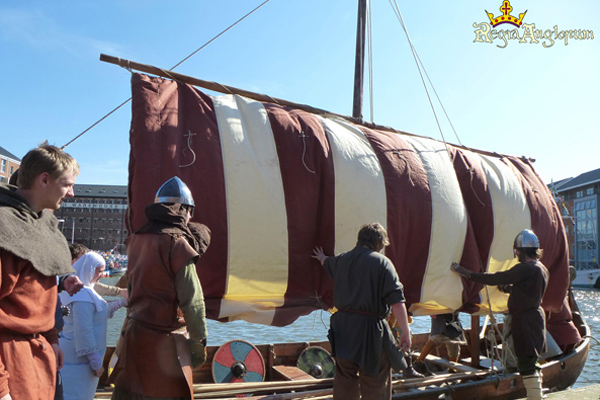
Re-enactment group, Regia Anglorum events feature meticulously researched, hand-crafted, and historically accurate Viking Age (approx. 750-1066 AD) tented encampments that act as a vibrant, immersive living history village. These are not mere shelters; they are furnished with museum-quality reproductions, including large-scale canvas tents, cooking hearths, and period furniture, all designed to transport visitors back over 1,000 years. ‘Regia Anglorum’ means The Kingdoms of the English-speaking people.
Members live in and work from these tents, demonstrating a wide array of daily, domestic, and military skills to the public.
Visitors can observe or “have a go” at crafts such as woodworking with pole lathes, textiles on warp-weighted looms, embroidery, coin-striking, and leatherworking.
The tents and their contents are built by members using, wherever possible, materials and techniques appropriate to the period. These living history displays aim to dispel myths about the Dark Ages, presenting a balanced, interactive view of both civilian life and military society.
Everything in the mediaeval world was made by hand; from simple carved wooden spoons and bowls to highly intricate embroidery and jewellery. Farmers, carpenters, blacksmiths, weavers, cooks, merchants, glassblowers and many more all made up the rich tapestry of crafts and trades. One wool dress would pass through the hands of shepherds, spinners, weavers, dyers, and dress makers to become what it is. Walk through our camp and into the lives of people who existed a millennium ago. Our members have dedicated themselves to learning various skills to accurately portray the daily existence of people who have been lost to time.
10am -4pm, Saturday 30th May – WARRIOR TRAINING on the Grange and traditional Viking and Anglo-Saxon Crafts in the Priory grounds and Priory.
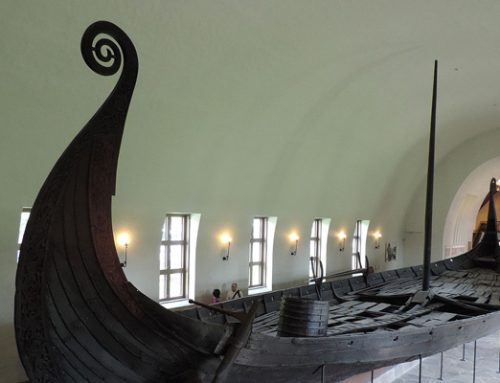
11.30am Saturday 30th May, Leominster Priory – VIKING BURIAL in the iconic Norman Nave of Leominster Priory witness a re-enactment of a ship burial for a fallen Viking. The authentic burial rituals, including the placement of weapons, shields, and personal grave goods, will be explained as the demonstration takes place.
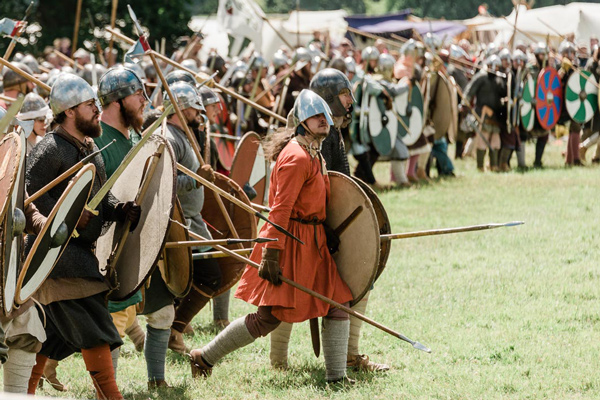
3pm Saturday 30th May, The Grange – BATTLE Small skirmishes and mighty battles
8.30pm Saturday 30th May, Leominster Priory – ANGLO-SAXON NIGHT PRAYER Join Regia Anglorum for an authentic Anglo-Saxon Compline (Night Prayer). Listen to the singing of Latin and Anglo-Saxon prayers by candlelight in Leominster Priory which has one of the best acoustics in the country, and was founded in 660. The prayers reflect the deep piety and structured religious life of the late Anglo-Saxon period, which was a core pillar of their society.
10am -4pm, Saturday 31st May WARRIOR TRAINING on the Grange
3pm Saturday 31st May, The Grange – BATTLE Small skirmishes and mighty battles
Much of the history of the early mediaeval era is written in blood. From Viking raids to clashes of kings, with generational grudges and pursuits for wealth and glory, bloody conflicts between armies and nations stretched across the era. Our time period encompasses the raids on Lindisfarne, the descending of the Great Heathen army upon Britain, the Battles of York, Maldon, Eddington, and the battle that would end the age: Hastings.
Prepared to defend their homeland or go and seek adventure abroad, Regia Anglorum warriors are trained and ready to take their place in the shield wall. Armed with spears, axes, swords, and more, our armies bring to life the sounds and stories of battlefields of old. Above all, our warriors seek “word fame,” that their great deeds will long outlive them and the legends of their success will never fade from men’s lips. Our warriors carry fully authentic replicas of period weapons and war-gear and are trained in a competitive combat style, which makes for dramatic and entertainingly brutal, but family friendly show pieces. Our timetabled battles and skirmishes are narrated and can be accompanied with dramatic music.
11.30 Sunday 31st May, Leominster Priory – VIKING AND ANGLO—SAXON FASHION SHOW
Saxon and Viking clothing was very similar,both using materials like wool and linen for tunics, trousers, and cloaks. Key differences were subtle: Vikings often utilized more cattle leather, distinctive apron-dresses for women fastened with brooches, and, over time, adopted more Eastern styles like kaftans. Viking women typically wore a linen under-dress with a wool apron-dress fastened by two brooches on the shoulders. Anglo-Saxon women often wore a more traditional, simpler gown (gunna) or a draped, one-piece garment.
Viking fashion often featured intricate tablet weaving, embroidery, and, in the earlier period, distinct brooches. While both wore trousers, Saxons were more likely to wear wrapped leggings (winingas) or closely fitted, spiraled leg-wrappings, a feature sometimes less common in early Norse attire. While both used sheep’s wool and linen, Vikings were noted for using vaðmal, a dense, durable wool cloth, and more extensive leatherwork.
Both wore tunics (often with decorated necklines/cuffs), trousers (braes), and wool cloaks fastened at the shoulder. Both used similar vegetable dyes to create colors like red (from madder), blue, and brown.
Ultimately, especially by the late 9th and 10th centuries, clothing styles in England became very similar due to the cultural blending of Anglo-Saxon and Anglo-Scandinavian population. Finds of clothes from the Viking period are rare. These often consist of small pieces of material preserved by chance. Our knowledge about Viking clothes is supplemented by written sources, as well as clothes depicted on small figures and tapestries. Like today’s men and women, the Vikings and Anglo Saxons dressed according to sex, age and economic status. The Vikings also had distinctive hair-styles and were known for their tattoos.
The clothes of the richest women were depicted on pendants, showing significant variations in their attire. Women’s pinafores, trains and cloaks, could be decorated with various bands and border stitching. Clothes were woven in many different colours. Coloured yarn could be produced in the Viking Age by boiling the material with various colour-yielding plants. The colours that archaeologists know were used in Viking Age clothes are yellow, red, purple and blue. Blue has only been found in the burials of wealthy individuals, as it was apparently a precious colour. The blue colour came from either the local plant woad or the dye indigo, which was purchased abroad.
Around 40% of finds of Viking Age fabric have been identified as flax. Flax must therefore have been an important plant for the production of Viking clothes. Research shows that more than 20 kg of flax plants was needed to produce enough material to make a tunic. In addition, the task – from when the flax was sown until the tunic was stitched – probably required almost 400 work hours. Several sites have been found in Denmark, at which flax was produced on an almost industrial scale. Flax must therefore have been an important product in Viking Age trade.
Jewellery in the Viking Age
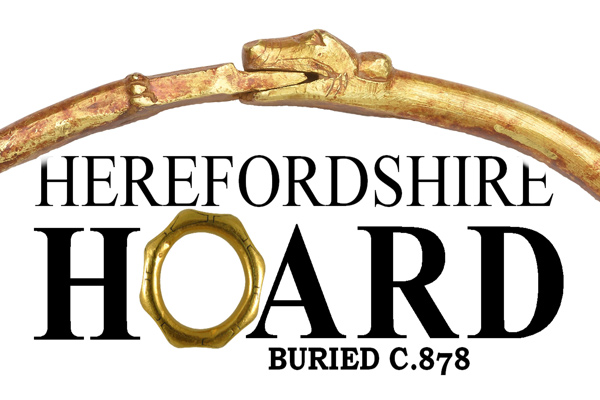
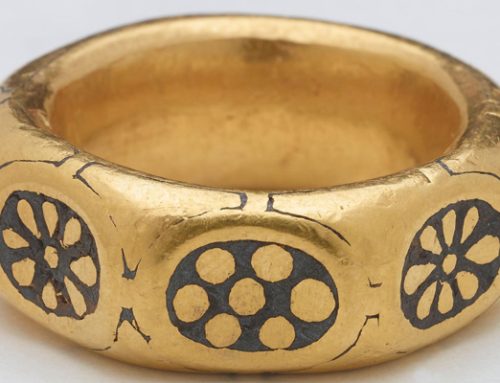
Men and women from all layers of society wore jewellery, in the form of arm rings, necklaces and brooches. Some of the jewellery was ornamental and it could also indicate wealth. Other items, such as brooches, often had a practical function as well – to fasten clothes. In addition, there were pieces of jewellery that had symbolic value, such as Thor’s hammers. Apparently the Vikings did not wear ear rings but must have encountered them on expeditions where they came into contact with Slavic peoples. Jewellery could be made from various materials, such as wood, glass, amber, bronze and gold. Pieces of jewellery were often decorated with geometric designs, plaited bands, and most importantly, including animal heads and gripping beasts.